For most of my life, I have been a musician.
I have spent decades singing, playing piano, teaching students, directing choirs, rehearsing, performing, and studying the craft of music. There are certainly always new things to learn, but music is a language I know well. I understand the vocabulary. I know what it feels like to walk into a rehearsal room. I know how to practice. I know how to recover from mistakes.
Then I started playing tennis.
And suddenly, I was a beginner again.
I had to learn an entirely new vocabulary. I had to think about where to put my feet, how to hold the racquet, when to move, where the ball was going, and somehow convince my body to do several unfamiliar things at once.
Sometimes I missed.
Sometimes I missed spectacularly.
There were days when something clicked, and days when I wondered how something I had done perfectly well the week before had apparently disappeared overnight.
Most importantly, I remembered what it feels like to learn something new as an adult.
Being a Beginner Takes Courage
We often associate lessons with childhood.
Children take piano lessons. Children join sports teams. Children try things they are not yet good at, and we expect them to be beginners.
Adults can be much harder on themselves.
We walk into a lesson carrying decades of expectations. We think we should understand faster. We compare ourselves to people who have been doing something much longer. We apologize when we make mistakes.
Sometimes we avoid beginning at all because we are afraid of looking foolish.
Tennis reminded me just how vulnerable learning can feel.
It also reminded me how exhilarating it can be.
There is a particular kind of joy in realizing that something you once could not do has gradually become something you can.
One day you make contact with the ball.
Then you begin sustaining a rally.
Eventually, you find yourself doing things that seemed impossible when you started.
Music works that way, too.
Progress Rarely Happens in a Straight Line
One of the most useful things tennis taught me is that improvement does not always look like improvement.
You can have a wonderful day followed by a frustrating one.
You can understand something intellectually long before your body knows how to reproduce it consistently.
You can work on one small adjustment for weeks and then suddenly realize that it has become automatic.
Musical learning is remarkably similar.
A singer may understand a new breathing concept but need time before it becomes instinctive.
A pianist may practice a passage slowly for days before the hands finally cooperate.
Sometimes the breakthrough happens quietly.
One day the note feels easier.
One day the rhythm is secure.
One day you realize that you are no longer thinking consciously about something that once required enormous concentration.
That is learning.
And it deserves patience.
The Right Teacher Matters
My experiences as a tennis student also reinforced something I have always believed as a music teacher:
People learn best when they feel safe enough to try.
Fear is not a particularly good teacher.
Neither is embarrassment.
Students need honest feedback, of course. Growth requires correction. But correction does not have to be harsh in order to be effective.
A good lesson should be a place where you are allowed to experiment.
You should be able to miss the ball.
Crack the note.
Play the wrong key.
Lose your place.
Ask the question you think you “should” already know the answer to.
And then try again.
One of the most important jobs a teacher has is helping a student understand that mistakes are not evidence that they do not belong.
Mistakes are part of the process.
Music Lessons Can Be About More Than Music
Tennis eventually became much more than a sport in my life.
It challenged me physically and mentally. It introduced me to new people. It gave me something to work toward. It helped me build confidence in an area where I had once had none.
It reminded me that there were still entirely new versions of myself waiting to be discovered.
That experience changed the way I think about adult music lessons.
Of course, we can work on vocal technique, breath support, repertoire, piano skills, rhythm, sight-reading, interpretation, or whatever musical goals bring you through the door.
But sometimes something else happens along the way.
A person who has always been afraid to sing discovers that their voice deserves to be heard.
Someone who played piano decades ago realizes that an important part of themselves was never really lost.
Someone who thought they were “not musical” discovers that they simply needed patient instruction.
Someone who spends most of life meeting responsibilities finally has one hour that belongs to creativity.
That matters.
You Are Allowed to Start
You do not need to be young to begin music lessons.
You do not need previous training.
You do not need to know how to read music.
You certainly do not need to impress me.
You just need curiosity and a willingness to learn.
If tennis taught me anything, it is that being a beginner is not something to be embarrassed about.
It means you are brave enough to enter unfamiliar territory.
And sometimes the thing you begin simply because it looks interesting becomes far more important than you ever expected.
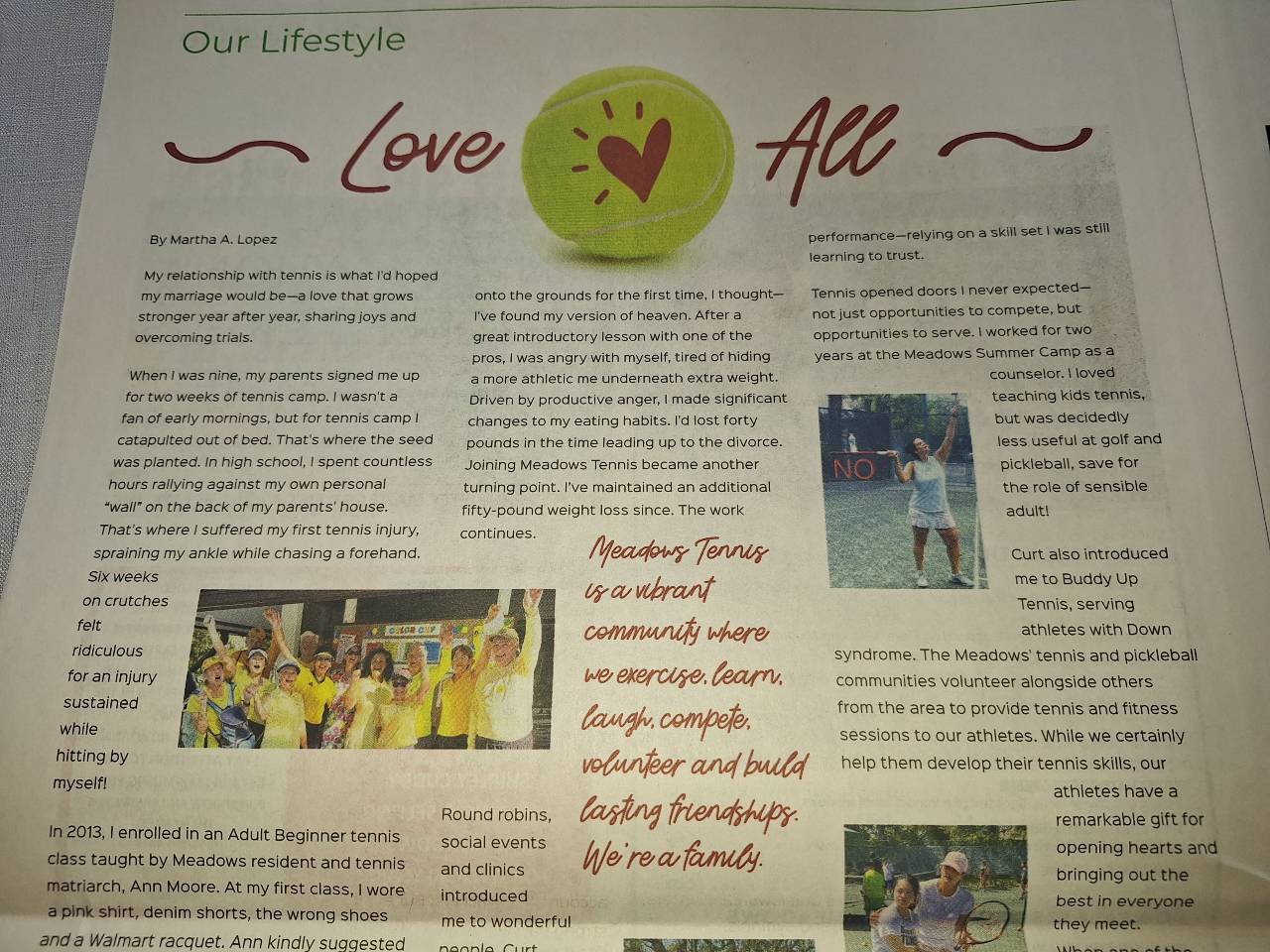
I recently wrote about my own experience with tennis and the unexpected role it came to play in my life in an article called “Love All.”
You can read it here:
Although the article is about tennis, in many ways it is really about learning, resilience, community, and discovering that life can still surprise us.
Those are lessons I carry with me onto the tennis court.
And into every music lesson I teach.
If you have been thinking about taking voice or piano lessons—or returning to music after many years—I would be delighted to help you begin.
You do not have to know how far you want to go.
You only have to take the first step.